How to Visit Petra: A Complete Guide for Travelers
Everything you need to know before visiting Petra: how to get there, the must-see sites, the ideal length of stay and advice from a guide who works there year-round.

Khaldoun Aljarrah
Licensed private tour guide · Jordan
Carved directly into the rose-red rock of the Nabataean cliffs, Petra is arguably the most spectacular site in the Middle East. A UNESCO World Heritage Site and one of the New Seven Wonders of the World, the rose city draws hundreds of thousands of visitors from around the globe every year. Yet visiting Petra well is not something you can improvise. Here is everything you need to plan your visit properly.
How do you get to Petra from your hotel?
Petra sits in southern Jordan, in the town of Wadi Musa. If you are based in Amman, allow around 3 hours by the Desert Highway. From Aqaba, on the Red Sea, the drive is about 1 hour 30 minutes. From Wadi Rum, count on 1 hour 30 minutes to 2 hours. The vast majority of travelers opt for a private transfer with their guide, which removes the logistical headaches and lets you start the visit relaxed the moment you arrive.
- From Amman: around 3 hours of driving (240 km)
- From Aqaba: around 1 hour 30 minutes (130 km)
- From Wadi Rum: around 1 hour 30 minutes to 2 hours (80 km)
- From the Dead Sea: around 2 hours 30 minutes (165 km)
When is the best time to visit Petra?
Jordan is open year-round, but some months are far more comfortable than others. March, April, October and November bring mild temperatures (15–25 °C), ideal for walking several hours inside the site. In summer (June–August) it can get very hot in the middle of the day — up to 38 °C in the canyon — so you need to set off early in the morning. In January and February, Petra can be cool and even rainy, but the crowds are much thinner.
The must-see sites you should not miss
Petra spreads across more than 260 km² of gorges, rock-cut temples and royal tombs. Even with two full days, seeing everything is difficult. These are the sites every visitor should make a point of reaching:
- The Siq — the winding 1.2 km gorge leading to the Treasury: a spectacle in its own right
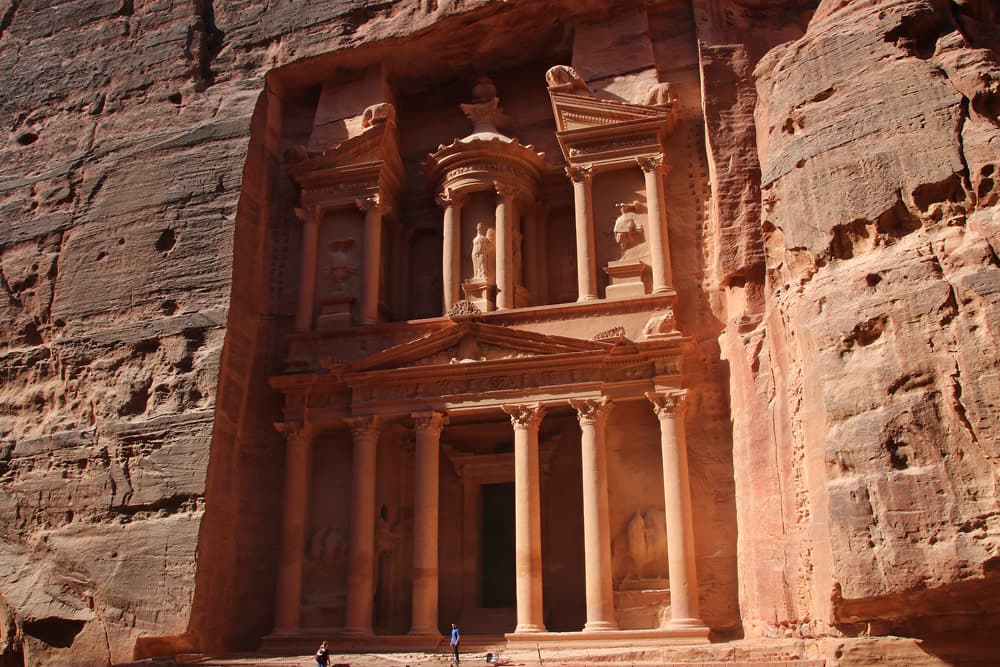
- Al-Khazneh (the Treasury) — the iconic carved façade, 43 metres high
- The Colonnaded Street — the main artery of the Nabataean city
- The Monastery (Ad-Deir) — 800 steps up, and worth every one of them
- The High Place of Sacrifice — an exceptional panorama over the whole city
- The Royal Tombs — a row of façades cut into the ochre cliff face
How long do you need to visit Petra?
This is the question every traveler asks. The honest answer depends on your pace and your ambitions. In one day you can see the main sites: the Siq, the Treasury, the Colonnaded Street and the Royal Tombs. With two days you can add the Monastery and the High Place of Sacrifice, and take time to explore the quieter quarters. Three days allow an almost complete exploration of the site, including its lesser-known corners.
- 1 day: Siq, Treasury, Colonnaded Street, Royal Tombs (roughly 12–15 km on foot)
- 2 days: + Ad-Deir Monastery, High Place of Sacrifice, Little Petra
- 3 days: full exploration including the outlying sectors and the hiking trails
Petra By Night: an experience apart
Three evenings a week (Monday, Wednesday and Thursday), Petra opens for a night visit: the Siq and the esplanade in front of the Treasury are lit by hundreds of candles set along the path. The atmosphere is spellbinding, silent, almost mystical. The visit lasts around 90 minutes and includes a performance of traditional Jordanian music in front of the Treasury. It leaves a lasting impression, and is well worth adding if your schedule allows.
Practical advice for your visit
- Wear closed, comfortable walking shoes — the ground is rocky
- Start your visit as soon as the gates open (6 a.m.) to beat the crowds and the heat
- Bring at least 2 litres of water per person for a full day
- Pack sunscreen and a hat, especially in summer
- Entry is included in the Jordan Pass, which also waives the entry visa fee
- Do not judge by photos alone: the walk up to the Monastery is long but worth every step
Visiting Petra with a private guide
Petra is vast and complex: its 800 recorded sites, its Nabataean history and its legends make far more sense with a local guide. Visiting with a private guide gives you precise storytelling and details you will not find in a guidebook, stress-free organisation (logistics, tickets, pacing) and the freedom to ask every question that comes to mind. Khaldoun Aljarrah, a licensed guide with more than 15 years of experience, accompanies travelers through Petra throughout the year.
Discover our tour covering Petra, Wadi Rum and the Dead Sea — guided in person by Khaldoun.
See the Petra, Wadi Rum & Dead Sea tour
